
Duisburg Hbf signal box: a German signal box in the simulation
Duisburg Hauptbahnhof sits on the busy line between Cologne, Düsseldorf and the Ruhr. In Treindienstleider Simulator you run the station from a German ESTW workstation (electronic signal box), with Ks signals, train routes and automatic routing (Zuglenkung). It is the first station outside the Netherlands in the simulation.
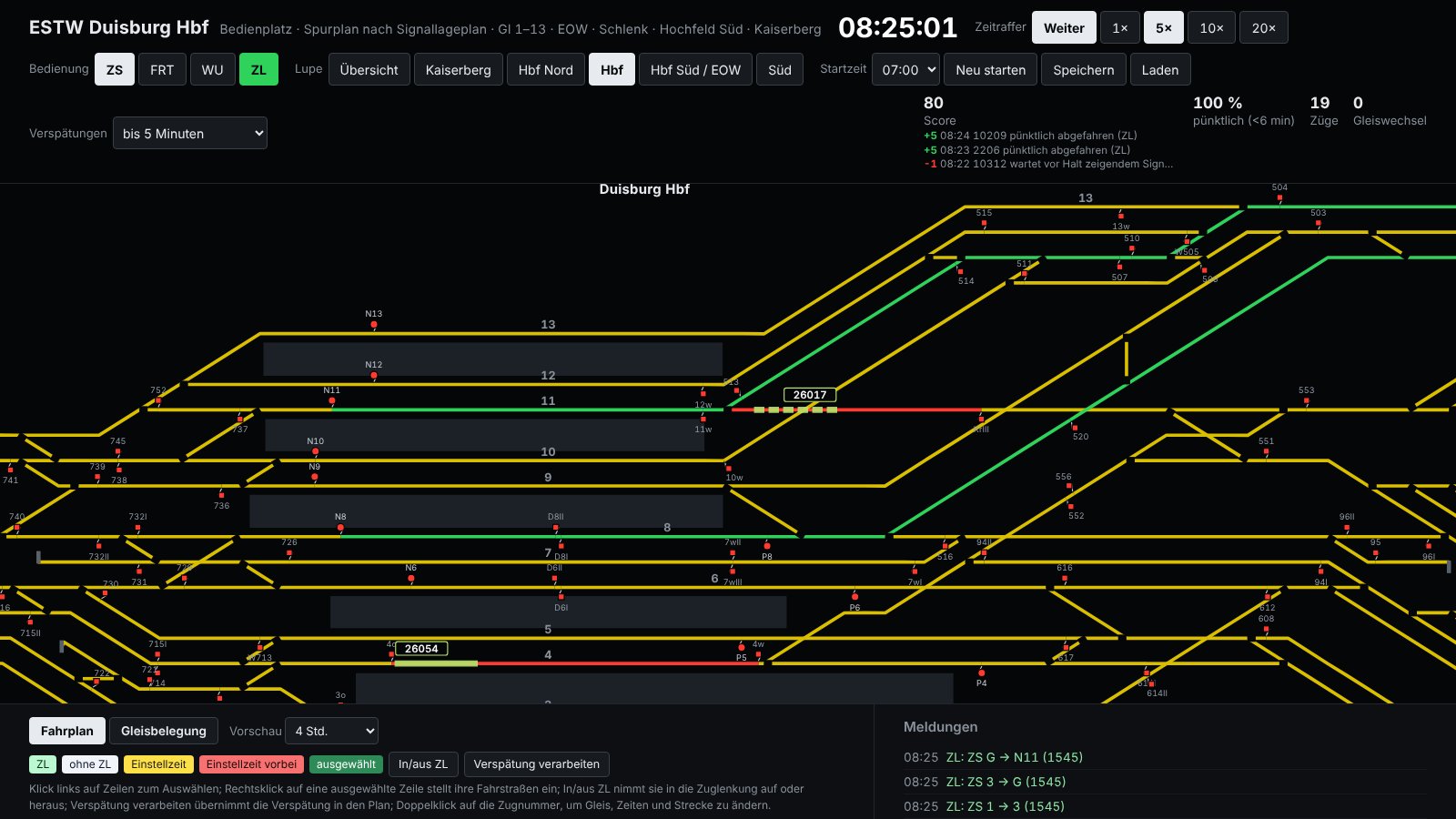
The station
| Part | In the simulation |
|---|---|
| Track plan | The whole area of the Duisburg Hbf signal box after the signalling plan, with the real signal, point and track section numbers. Only long stretches of open line are shortened. |
| Platform tracks | Tracks 1 to 13. Southbound trains leave from the P signals of tracks 1–6 and 8 (plus through track 400), northbound trains from the N signals of tracks 1, 6 and 8–13. |
| North side | Kaiserberg junction with the lines to Mülheim-Styrum (S-Bahn and main line), Oberhausen and the freight line via Mathilde junction to Ruhrort. |
| South side | Duisburg-Schlenk on the lines to Düsseldorf (main line, S-Bahn and freight track), with the S 1 stop. Duisburg-Hochfeld Süd and the Rhine bridge to Rheinhausen, with the RB 33 and RB 35 stop. Plus the connections to Wedau and the Wedau marshalling yard. |
| EOW depot | The stabling yard with 17 tracks. The RB 31 shunts there after arrival and is brought out again before departure. |
Different from the Netherlands
- Ks and Ls signals: main signals show red (Hp 0), yellow (Ks 2: the next signal is at stop) or green (Ks 1). The small Ls signals show Sh 0 or Sh 1 for shunting moves.
- Train routes and shunting routes: you click the start signal and then the destination signal. Valid destinations light up. If the shortest way is blocked, the interlocking picks an alternative itself. Cancelling a route is called FRT, switching a point WU.
- Zuglenkung (ZL): the German counterpart of ARI. It also sets the shunting routes to and from the depot. You switch it on or off for all trains or per train.
- Lupe: you choose the view (overview, Kaiserberg, Hbf north, Hbf, Hbf south with the depot, or the south with Schlenk and Hochfeld Süd). Use the mouse wheel to zoom and drag to move the view.
- Track occupation and delay: a track occupation chart of tracks 1 to 13 and a choice of random delay (none to more than 15 minutes), just like the Dutch signal boxes.
- In three languages: buttons, messages, statuses and explanations are available in Dutch, English and German; the German technical terms (Zugstraße, Ks 1, Hp 0) are kept.
- Scoring: the same score as in Amersfoort and Arnhem, with points for running on time and for routes you set yourself, and deductions for delay and waiting at red.
Which trains run?
The timetable follows the Duisburg Hbf departure table valid from June 2026. On a weekday almost 800 trains run in the simulation. A selection:
- ICEs to Munich, Basel, Berlin and Hamburg, and the ICE between Amsterdam and Frankfurt.
- The IC to Norddeich Mole and the RRX lines RE 1, RE 5, RE 6 and RE 11.
- The RE 19 towards Wesel, Bocholt and Arnhem, the RE 2, RE 3 and RE 42, and the S 1 between Dortmund and Solingen.
- The RB 31 to and from Xanten, which ends and starts in Duisburg with a shunting move to and from the depot, the RB 33 to Aachen and the RB 35 to Gelsenkirchen.
- Freight trains between Ruhrort, the freight track to Düsseldorf, Wedau and Oberhausen. Set their routes one after the other and they run straight through without stopping.
The busiest moments
Around the full hour, trains leave in all directions within a few minutes: the RE 19 and the RE 42, shortly followed by the southbound ICE and the S 1. In the southern throat the trains to Düsseldorf cross the trains from Rheinhausen and the shunting moves to the depot. When a train arrives late you have to choose: wait for the planned track, or send it to another one.
As real as possible
The track plan follows the signalling plan of the Duisburg Hbf signal box by Signalsoft Rail Consultancy, with the real names of signals and points. Departure times, train numbers and platforms come from the official departure table (08:00–09:00, weekdays), repeated through the day and adapted to the routes in the plan. Train numbers outside that hour, arrival times, the RB 31 turnaround and freight trains are approximated.
Play all signal boxes free for 5 days, no payment details needed. Or practise first at the free Hazendonk station.
Treindienstleider Simulator is an independent simulation based on public sources and the signalling plan by Signalsoft Rail Consultancy, and is not affiliated with Deutsche Bahn or DB InfraGO.